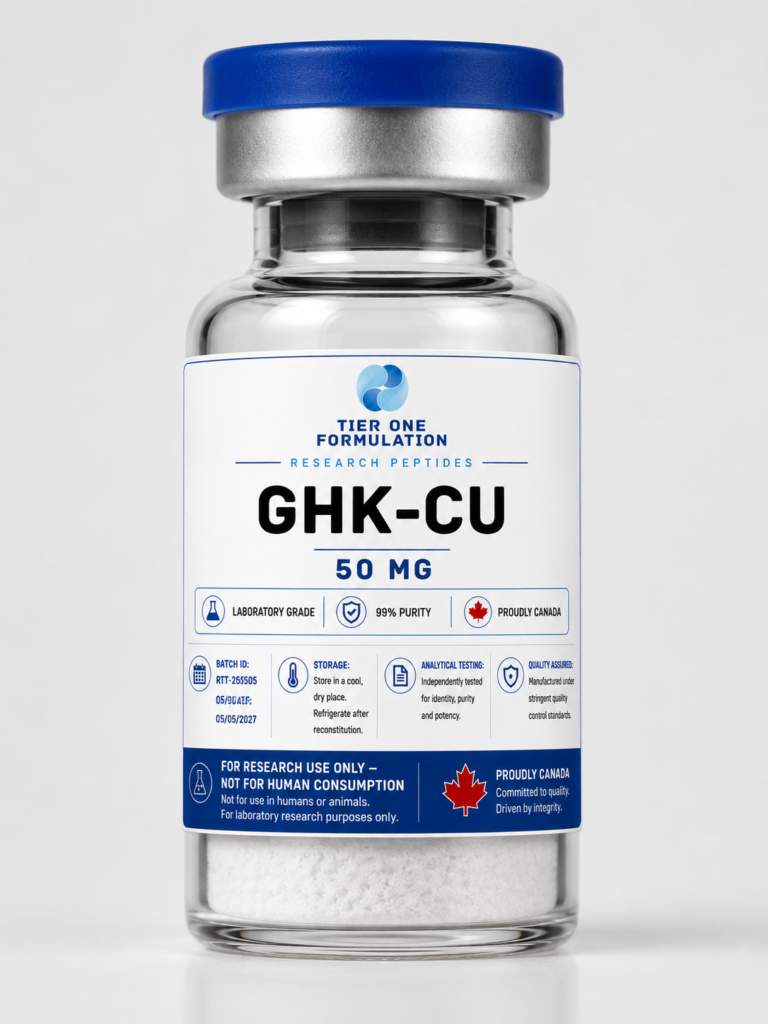
GHK-Cu Copper Peptide Canada: 50mg Research Overview
GHK-Cu 50mg provides a Canadian research format of the copper complex formed by the tripeptide glycyl-L-histidyl-L-lysine. GHK-Cu research intersects copper homeostasis, extracellular-matrix biology, gene-expression responses and cell-remodelling pathways. Those observations come from varied biochemical, cell and preclinical models and should be interpreted within the material identity and methods of each study.
Quick Research Profile
| Material |
GHK-Cu (glycyl-L-histidyl-L-lysine copper) |
| Strength |
50mg |
| Research classification |
Copper-binding tripeptide complex |
| Primary research pathways |
Copper signalling, extracellular matrix, fibroblast, collagen and tissue-remodelling research |
| Literature status |
Mechanistic, cell, animal and selected human/cosmetic literature; context varies by model |
| Intended use |
Laboratory research only — not for human or veterinary use |
Copper Binding, Matrix Signalling and Gene-Expression Research
The GHK sequence coordinates copper ions and can influence cellular responses through copper-dependent and peptide-signalling mechanisms. Published studies and reviews discuss effects on collagen and glycosaminoglycan synthesis, matrix metalloproteinases, fibroblast activity and gene-expression patterns. Mechanistic observations differ by system and should not be generalized into treatment claims.
Key GHK-Cu Research Areas
- Copper-peptide research: GHK-Cu is a model for peptide-mediated copper binding and cellular copper signalling.
- Extracellular-matrix research: Studies examine collagen, glycosaminoglycans, metalloproteinases and matrix remodelling.
- Fibroblast and wound-model biology: Cell and animal models have evaluated fibroblast responses and tissue-repair pathways.
Evidence Quality and Interpretation
GHK-Cu has a broader literature base than many experimental peptides, spanning biochemical, cell, animal and some human or cosmetic research. The relevance of any study depends on preparation, concentration, model and route used in that study.
Research Limitations and Responsible Interpretation
Do not infer cosmetic, therapeutic or human-use suitability from the literature. Batch identity and analytical characteristics should be confirmed from product-specific documentation.
Published findings describe specific experimental preparations and study conditions. They do not establish that a commercial research material is equivalent to a regulated pharmaceutical product, and they should not be interpreted as evidence of safety, efficacy or suitability for personal use.
Scientific References
References are provided for scientific context. Researchers should review the original methods, material identity, model and limitations before using published findings to inform experimental design.
Research FAQ: GHK-Cu (glycyl-L-histidyl-L-lysine copper)
What is GHK-Cu?
GHK-Cu is the copper complex of the tripeptide glycyl-L-histidyl-L-lysine. It is studied in relation to copper binding, extracellular-matrix signalling, gene-expression responses and cellular remodelling.
Why is copper central to GHK-Cu research?
The peptide’s biological identity is tied to copper coordination. Researchers investigate how the GHK-Cu complex differs from the uncomplexed peptide and how copper-dependent signalling may influence cellular responses.
What kinds of evidence exist for GHK-Cu?
The literature includes biochemical, cell and preclinical studies plus review literature. The relevance of any result depends on material preparation, concentration, model and endpoint.
Does GHK-Cu 50mg imply cosmetic or therapeutic use?
No. This is a laboratory research listing and is not positioned as a cosmetic, injectable, wound-care, anti-aging or other human-use product.
Canadian Research Procurement
Tier One supplies GHK-Cu 50mg for qualified Canadian research procurement. Researchers working with copper-binding peptide biology and matrix-signalling models can review the Copper Peptides collection for related materials. Any identity, purity or analytical statement should be confirmed from current product- or batch-specific documentation. For research purposes only. Not for human or veterinary use or consumption.