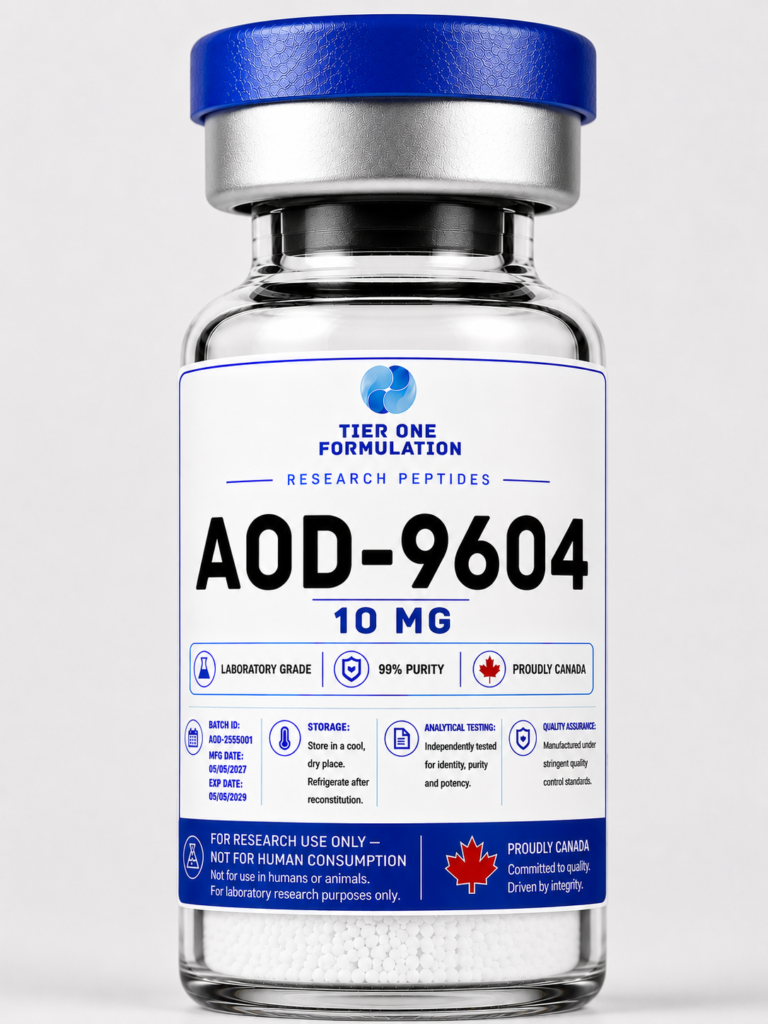
AOD-9604 Canada: 10mg Research Peptide Overview
AOD-9604 10mg is supplied in Canada for qualified laboratory research on a synthetic peptide derived from the C-terminal region of human growth hormone, commonly described in relation to residues 176-191. Historical research examined metabolic endpoints in animal models and early development programs. Those findings remain limited and should not be converted into claims of clinical fat loss, treatment benefit or personal-use suitability.
Quick Research Profile
| Material |
AOD-9604 |
| Strength |
10mg |
| Research classification |
Synthetic C-terminal human growth hormone fragment analogue |
| Primary research pathways |
Lipid-metabolism, lipolysis and beta-adrenergic-related research |
| Literature status |
Older preclinical and historical clinical-development literature; evidence is limited and mixed |
| Intended use |
Laboratory research only — not for human or veterinary use |
AOD-9604 and the hGH 176-191 Research Lineage
Animal research has examined AOD-9604 in relation to fat oxidation, lipolytic sensitivity and beta-adrenergic pathways. Some studies reported changes in beta3-adrenergic receptor expression while also suggesting that the observed metabolic effects were not simply caused by direct beta3-receptor binding. The exact mechanism remains incompletely defined.
Key AOD-9604 Research Areas
- Growth-hormone fragment research: AOD-9604 is used to study a defined C-terminal hGH-derived sequence.
- Lipid-metabolism models: Preclinical studies have measured fat oxidation, body composition and lipolysis-related endpoints.
- Adrenergic-pathway research: Older animal work examined beta-adrenergic receptor expression and metabolic responses.
Evidence Quality and Interpretation
The most frequently cited AOD-9604 studies are older animal experiments, alongside historical drug-development literature. This evidence does not support broad claims of effectiveness, and contemporary human evidence is limited.
Research Limitations and Responsible Interpretation
AOD-9604 should not be represented as an established weight-loss therapy. Preclinical metabolic effects cannot be converted into personal-use conclusions, and commercial research materials should be evaluated independently.
Published findings describe specific experimental preparations and study conditions. They do not establish that a commercial research material is equivalent to a regulated pharmaceutical product, and they should not be interpreted as evidence of safety, efficacy or suitability for personal use.
Scientific References
References are provided for scientific context. Researchers should review the original methods, material identity, model and limitations before using published findings to inform experimental design.
Research FAQ: AOD-9604
What is AOD-9604?
AOD-9604 is a synthetic peptide developed from the C-terminal region of human growth hormone and is commonly discussed in relation to the hGH 176-191 fragment research lineage.
What did early AOD-9604 research examine?
Historical studies focused largely on metabolic and lipid-related endpoints in animal models and early development work. These findings remain limited and do not establish clinical fat-loss efficacy.
Is AOD-9604 the same as full-length growth hormone?
No. It is a peptide fragment-derived research compound and should not be interpreted as equivalent to full-length human growth hormone or its complete receptor biology.
Is the 10mg product intended for weight-loss use?
No. Tier One supplies AOD-9604 10mg only for qualified laboratory research, with no human dosing, treatment or weight-loss application implied.
Canadian Research Procurement
Tier One supplies AOD-9604 10mg for qualified Canadian research procurement. Researchers comparing metabolic signalling and multi-receptor research materials can browse the GLP-1 / Metabolic Peptides collection for related products. Product-specific identity, purity and analytical statements should be confirmed from current batch documentation. For research purposes only. Not for human or veterinary use or consumption.