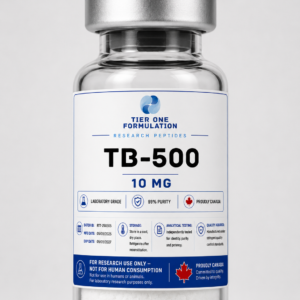
BPC-157 Canada: 10mg Research Peptide Overview
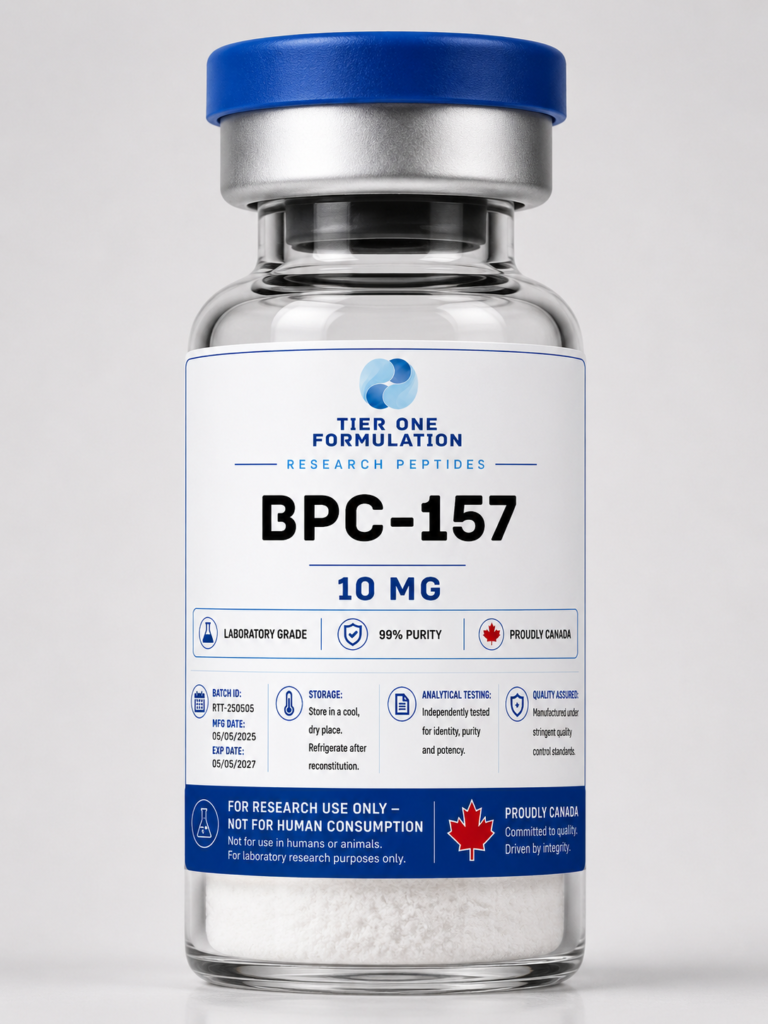
BPC-157 10mg is supplied for laboratory research in Canada. BPC-157 is a synthetic pentadecapeptide commonly described in the literature as a stable gastric peptide, with preclinical studies spanning gastrointestinal tissue, vascular signalling, tendon and muscle models. The strongest body of evidence remains experimental rather than clinical, making careful separation of mechanistic findings from human-use claims essential.
Quick Research Profile
| Material |
BPC-157 |
| Strength |
10mg |
| Research classification |
Synthetic 15-amino-acid research peptide |
| Primary research pathways |
Angiogenesis, VEGF-related signalling, gastrointestinal and connective-tissue research |
| Literature status |
Primarily preclinical animal and cell-model literature; human evidence remains limited |
| Intended use |
Laboratory research only — not for human or veterinary use |
BPC-157 Mechanistic Research: Angiogenesis and Tissue Models
Published studies have examined BPC-157 in relation to angiogenic signalling, VEGF expression, endothelial responses and tissue-repair pathways. The proposed biology is complex and not fully established; different experimental models report different downstream effects. These observations should be treated as research hypotheses and mechanistic context rather than clinical claims.
Key BPC-157 Research Areas
- Gastrointestinal research: BPC-157 appears in experimental gastric and intestinal tissue models.
- Tendon and muscle models: Preclinical work has studied connective-tissue healing, tensile strength and recovery-related endpoints.
- Angiogenesis and vascular signalling: Studies have evaluated VEGF expression, vascular response and angiogenic modulation.
Evidence Quality and Interpretation
The BPC-157 literature contains a substantial number of preclinical publications, including rat and cell-model studies. The quantity of preclinical work should not be confused with strong human evidence; robust clinical validation remains limited.
Research Limitations and Responsible Interpretation
No product page can establish efficacy, safety or suitability for human use. Findings are model-specific, and the identity and quality of a commercial research material must be determined from its own analytical documentation.
Published findings describe specific experimental preparations and study conditions. They do not establish that a commercial research material is equivalent to a regulated pharmaceutical product, and they should not be interpreted as evidence of safety, efficacy or suitability for personal use.
Scientific References
References are provided for scientific context. Researchers should review the original methods, material identity, model and limitations before using published findings to inform experimental design.
Research FAQ: BPC-157
What is BPC-157?
BPC-157 is a synthetic 15-amino-acid peptide frequently described in the literature as a stable gastric pentadecapeptide. Most research has used animal or cell models rather than well-controlled human clinical studies.
Why do BPC-157 studies discuss VEGF and angiogenesis?
Several preclinical studies examine vascular responses, VEGF-associated signalling and angiogenic processes alongside gastrointestinal and connective-tissue models. Those findings are mechanistic observations, not proof of clinical healing.
What is the main limitation of the BPC-157 evidence base?
The literature is heavily preclinical. A sizeable number of experimental studies does not substitute for robust, independently replicated human evidence.
Is BPC-157 10mg presented for recovery or injury treatment?
No. Tier One supplies BPC-157 10mg only for laboratory research, not for human or veterinary use, injury treatment, recovery protocols or consumption.
Canadian Research Procurement
Tier One supplies BPC-157 10mg for qualified Canadian research procurement. Laboratories comparing tissue-remodelling, peptide-signalling and related preclinical materials can review the Repair & Recovery Peptides collection for additional research products. Product-specific identity, purity and analytical statements should be verified against the current batch documentation available for the material. For research purposes only. Not for human or veterinary use or consumption.