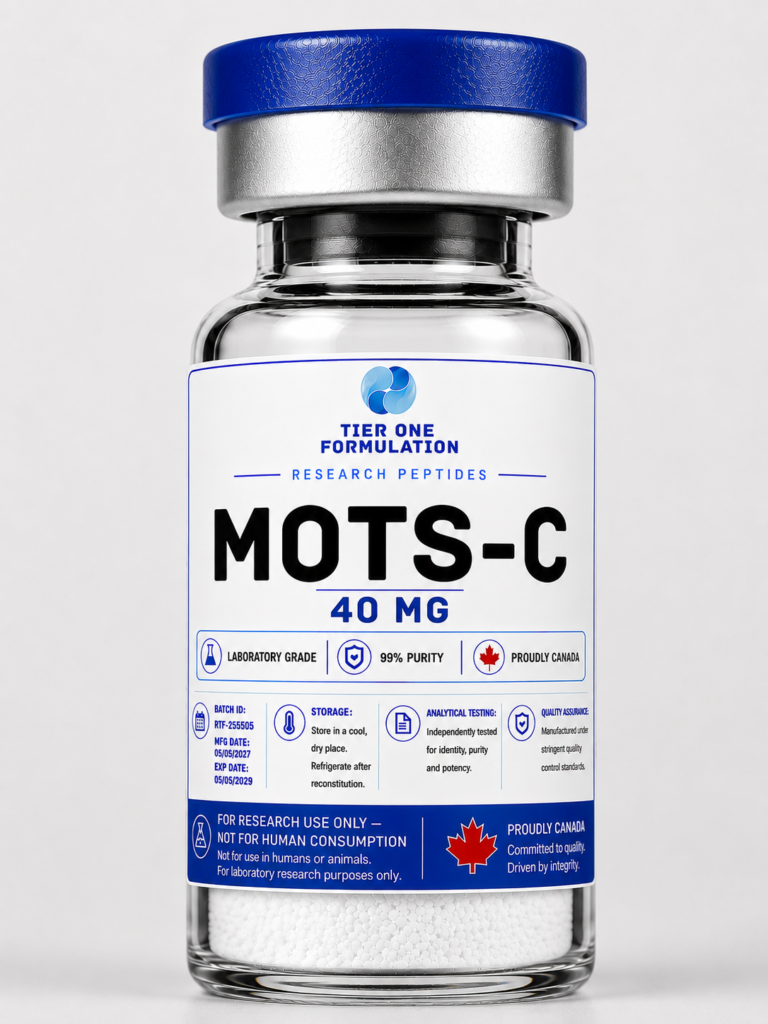
MOTS-C 40mg Canada: Mitochondrial Peptide Research
MOTS-C 40mg is a higher-quantity Canadian research listing of the mitochondrial-derived 16-amino-acid peptide MOTS-C. The page is intentionally differentiated from the 10mg listing by emphasizing experimental scale, stress-response biology and the reported movement of MOTS-C from mitochondria-associated signalling into nuclear gene-response pathways under selected conditions. The 40mg quantity is not a recommended dose or protocol.
Quick Research Profile
| Material |
MOTS-C |
| Strength |
40mg |
| Research classification |
Mitochondrial-derived 16-amino-acid peptide |
| Primary research pathways |
Mitochondrial stress signalling, AMPK-related metabolic pathways and nuclear gene response |
| Literature status |
Expanding preclinical mitochondrial-derived peptide literature |
| Intended use |
Laboratory research only — not for human or veterinary use |
Stress Signalling, Nuclear Responses and Higher-Quantity Research
MOTS-C research is often used to explore communication between mitochondrial state and wider cellular gene regulation. Experimental studies connect the peptide with metabolic-stress sensing, AICAR accumulation and AMPK-associated signalling, while stress-dependent nuclear translocation has been reported in selected models. This makes MOTS-C particularly relevant to questions about how a mitochondrially encoded peptide can influence responses beyond the organelle in which its sequence originates.
Key MOTS-C Research Areas
- Mitochondrial-to-nuclear communication: Researchers examine stress-dependent movement and changes in nuclear gene-expression programs.
- Energy-sensing pathways: AMPK-associated signalling and metabolic-stress responses are recurring mechanistic themes.
- Higher-quantity experimental procurement: The 40mg listing offers a different material quantity for laboratories without changing the underlying identity or biology of MOTS-C.
Evidence Quality and Interpretation
Evidence for MOTS-C remains weighted toward mechanistic cell research, animal models and review literature. The nuclear-response findings are scientifically interesting but do not establish clinical outcomes. Human and translational data remain substantially less mature than the laboratory evidence, so claims should stay close to the model and endpoint actually studied.
Research Limitations and Responsible Interpretation
The 40mg quantity is not a recommendation for experimental concentration, dosing or administration. Researchers should select protocols from validated laboratory methods and confirm product-specific identity and analytical documentation.
Findings from metabolic and stress-response models are not evidence of safety, therapeutic benefit or suitability for human or veterinary use.
Scientific References
References are provided for scientific context. Researchers should review the original methods, material identity, model and limitations before using published findings to inform experimental design.
Research FAQ: MOTS-C
Why does this MOTS-C page emphasize mitochondrial-to-nuclear signalling?
Experimental work reports that MOTS-C can participate in stress-response signalling and, under selected conditions, translocate to the nucleus and influence nuclear gene expression.
How is the 40mg listing different from MOTS-C 10mg?
It provides a different material quantity for research procurement. The biological identity remains MOTS-C, while this page focuses on higher-quantity experimental planning and stress-response context to avoid duplicating the 10mg page.
What is the evidence level for MOTS-C?
The field is driven mainly by mechanistic, cell and animal studies, supported by an expanding review literature. Translational evidence remains less developed.
Does 40mg correspond to a recommended experimental dose?
No. Product quantity and experimental dose are different concepts, and Tier One does not provide human dosing or administration guidance.
Canadian Research Procurement
Tier One supplies MOTS-C 40mg for qualified Canadian research procurement. Laboratories studying mitochondrial signalling, redox biology and cellular metabolism can browse the Mitochondrial Peptides collection for related research materials. Product-specific identity, purity and analytical statements should be confirmed from current batch documentation. For research purposes only. Not for human or veterinary use or consumption.