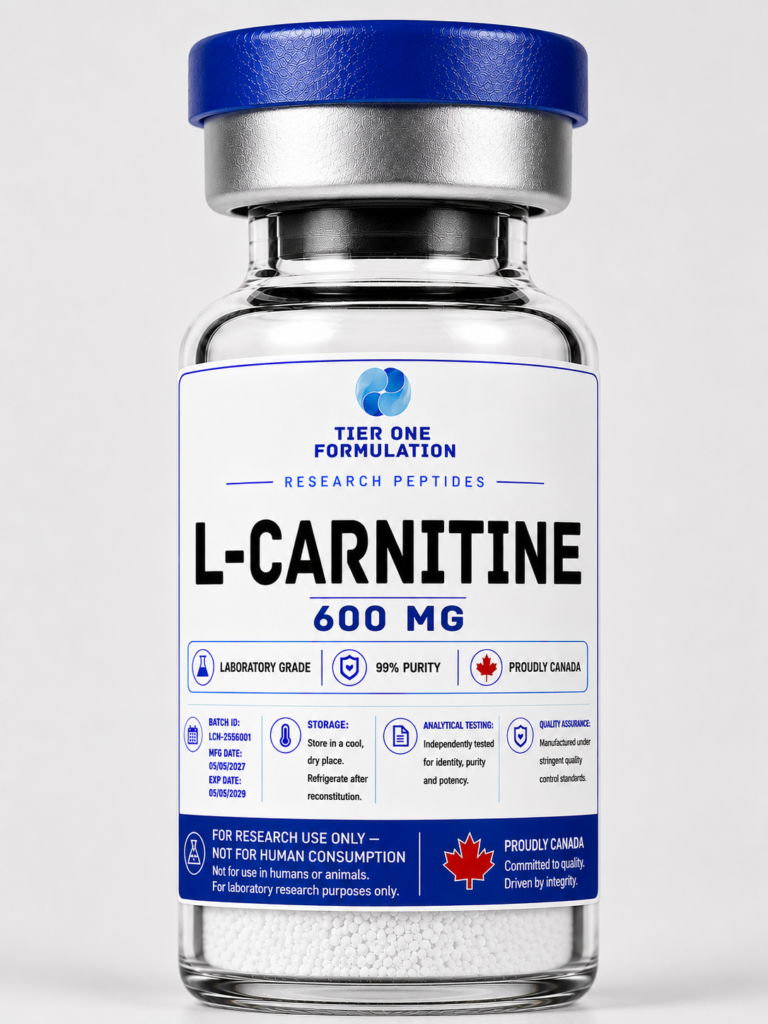
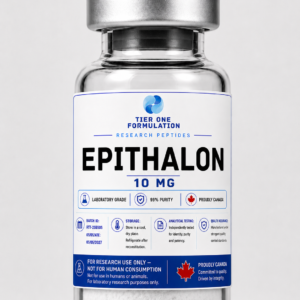
L-Carnitine Research Material Canada: 600mg Overview
L-Carnitine 600mg is supplied as a Canadian research material for laboratory investigation of carnitine transport and mitochondrial fatty-acid metabolism. L-carnitine plays an established biochemical role in shuttling long-chain acyl groups into mitochondria for β-oxidation, while transporters and acylcarnitine balance add additional layers of experimental interest. This listing is a research material, not a supplement or injectable wellness product.
Quick Research Profile
| Material |
L-Carnitine |
| Strength |
600mg |
| Research classification |
Quaternary ammonium amino-acid derivative / mitochondrial transport cofactor |
| Primary research pathways |
Carnitine shuttle, long-chain fatty-acid transport and mitochondrial β-oxidation |
| Literature status |
Extensive biochemical, metabolic and clinical literature |
| Intended use |
Laboratory research only — not for human or veterinary use |
Carnitine Shuttle Biology and Mitochondrial Fatty-Acid Oxidation
The carnitine system includes carnitine palmitoyltransferases and the carnitine-acylcarnitine translocase. Through this system, L-carnitine supports transfer of long-chain acyl groups into the mitochondrial matrix and helps buffer acyl-CoA/free-CoA balance. These functions make it a useful research material in mitochondrial and metabolic studies.
Key L-Carnitine Research Areas
- Mitochondrial fatty-acid transport: Carnitine is essential to the long-chain fatty-acid shuttle.
- β-oxidation research: Researchers use carnitine systems to study mitochondrial lipid oxidation.
- Acylcarnitine metabolism: Acylcarnitine profiles are studied as markers and intermediates of cellular metabolism.
Evidence Quality and Interpretation
L-carnitine biology is supported by extensive biochemical and clinical literature. This listing is for a research material and does not make claims about supplementation, exercise performance or disease treatment.
Research Limitations and Responsible Interpretation
The presence of broad clinical literature does not establish the intended use or quality of a specific laboratory product. Researchers should evaluate product identity and analytical documentation independently.
Published findings describe specific experimental preparations and study conditions. They do not establish that a commercial research material is equivalent to a regulated pharmaceutical product, and they should not be interpreted as evidence of safety, efficacy or suitability for personal use.
Scientific References
References are provided for scientific context. Researchers should review the original methods, material identity, model and limitations before using published findings to inform experimental design.
Research FAQ: L-Carnitine
What is the carnitine shuttle?
The carnitine shuttle transfers long-chain fatty-acyl groups across the inner mitochondrial membrane so they can enter β-oxidation pathways. L-carnitine is a central substrate in that transport system.
Why is L-carnitine relevant to mitochondrial research?
Researchers use carnitine and acylcarnitine measurements to study fatty-acid transport, mitochondrial metabolism and changes in cellular fuel handling.
Does established biochemistry make this product a supplement?
No. The biochemical role of L-carnitine is well established, but this Tier One listing is a laboratory research material rather than a supplement or clinical product.
What does 600mg mean on the listing?
It is the material quantity offered for research procurement and not a dosing, injection or administration instruction.
Canadian Research Procurement
Tier One supplies L-Carnitine 600mg for qualified Canadian research procurement. Laboratories studying mitochondrial signalling, redox biology and cellular metabolism can browse the Mitochondrial Peptides collection for related research materials. Product-specific identity, purity and analytical statements should be confirmed from current batch documentation. For research purposes only. Not for human or veterinary use or consumption.