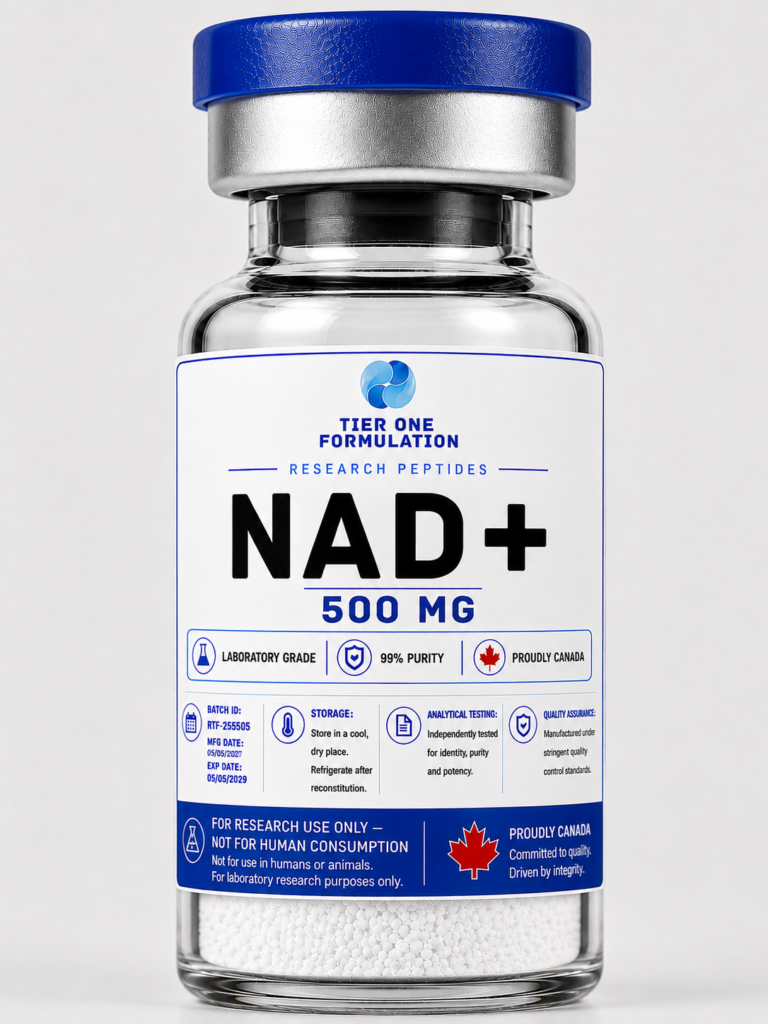
NAD+ Research Material Canada: 500mg Cellular Research
NAD+ 500mg is supplied as a Canadian research material for laboratory work on nicotinamide adenine dinucleotide, a core cellular redox coenzyme and consumed substrate for multiple signalling enzymes. NAD+/NADH chemistry connects central metabolism with sirtuin, PARP and CD38-family biology. The strength of the foundational biochemical literature does not make this listing a clinical infusion, supplement or anti-aging product.
Quick Research Profile
| Material |
Nicotinamide adenine dinucleotide (NAD+) |
| Strength |
500mg |
| Research classification |
Cellular redox coenzyme and signalling metabolite |
| Primary research pathways |
NAD+/NADH redox reactions, sirtuins, PARPs and metabolic signalling |
| Literature status |
Extensive biochemical and cell-biology literature |
| Intended use |
Laboratory research only — not for human or veterinary use |
NAD+/NADH Redox Biology, Sirtuins and PARPs
NAD+ accepts and transfers hydride equivalents in oxidation-reduction reactions, linking glycolysis, the tricarboxylic-acid cycle, oxidative phosphorylation and other metabolic pathways. NAD+ is also consumed by enzymes including sirtuins, poly(ADP-ribose) polymerases (PARPs) and CD38-family enzymes, connecting metabolism with signalling and DNA-response biology.
Key NAD+ Research Areas
- Redox metabolism: The NAD+/NADH couple is central to cellular oxidation-reduction chemistry.
- Sirtuin research: NAD+ availability is relevant to NAD+-dependent deacylase activity.
- PARP and DNA-response research: PARP enzymes consume NAD+ during poly-ADP-ribosylation and cellular stress responses.
Evidence Quality and Interpretation
NAD+ has one of the deepest biochemical literatures in cellular metabolism. That foundational biology supports laboratory use but should not be converted into claims about intravenous use, supplementation or anti-aging outcomes.
Research Limitations and Responsible Interpretation
A research reagent is not a clinical NAD+ product. No administration, therapeutic, longevity or wellness claim is made or implied.
Published findings describe specific experimental preparations and study conditions. They do not establish that a commercial research material is equivalent to a regulated pharmaceutical product, and they should not be interpreted as evidence of safety, efficacy or suitability for personal use.
Scientific References
References are provided for scientific context. Researchers should review the original methods, material identity, model and limitations before using published findings to inform experimental design.
Research FAQ: Nicotinamide adenine dinucleotide (NAD+)
Why is NAD+ central to cellular metabolism research?
NAD+ accepts and transfers reducing equivalents in core metabolic reactions, while the NAD+/NADH ratio is closely connected with cellular redox state and energy metabolism.
Which signalling enzymes consume NAD+?
Important NAD+-consuming enzyme families include sirtuins, poly(ADP-ribose) polymerases (PARPs) and CD38-family enzymes, linking NAD+ availability with signalling and stress-response biology.
Does NAD+ research support anti-aging or intravenous claims for this material?
No. Foundational biochemical and disease-model research should not be converted into claims about infusions, supplementation, longevity or therapeutic benefit.
What does the 500mg product quantity indicate?
It identifies the amount in the research listing and is not a dosing or administration recommendation.
Canadian Research Procurement
Tier One supplies NAD+ 500mg for qualified Canadian research procurement. Laboratories studying mitochondrial signalling, redox biology and cellular metabolism can browse the Mitochondrial Peptides collection for related research materials. Product-specific identity, purity and analytical statements should be confirmed from current batch documentation. For research purposes only. Not for human or veterinary use or consumption.