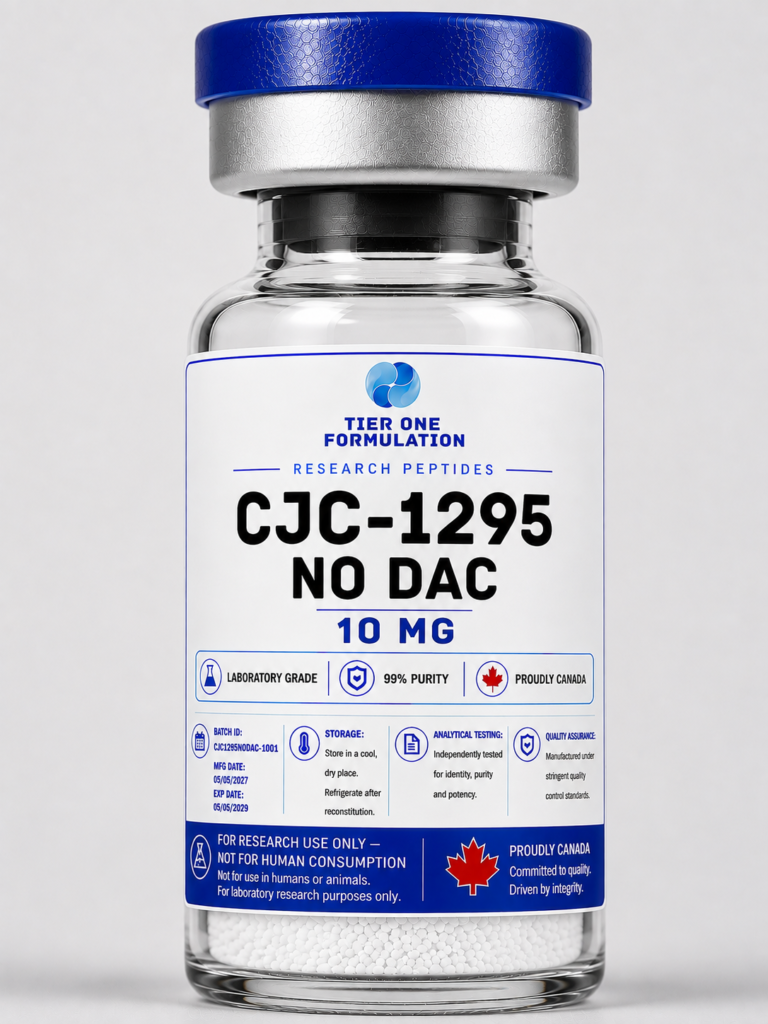
CJC-1295 No DAC Canada: 10mg GHRH Research
CJC-1295 No DAC 10mg is supplied in Canada for laboratory research on growth-hormone-releasing hormone (GHRH), also called growth-hormone-releasing factor (GRF), analogue pharmacology. In commercial research catalogs, “CJC-1295 No DAC” is commonly used for modified GRF(1-29)-type materials that do not contain the drug-affinity-complex modification associated with long-acting albumin-binding CJC constructs. Primary scientific literature uses several GRF/GHRH analogue names and sequences, so researchers should confirm the exact sequence and identity of the supplied batch rather than relying on market nomenclature alone.
Quick Research Profile
| Material |
CJC-1295 No DAC / modified GRF(1-29)-type research peptide |
| Strength |
10mg |
| Research classification |
GHRH/GRF analogue peptide |
| Primary research pathway |
Growth-hormone-releasing hormone receptor signalling |
| Research themes |
GRF receptor binding, peptide stability, pituitary signalling and analogue structure-activity relationships |
| Literature status |
GRF/GHRH analogue literature includes in vitro, animal and historical human research; exact analogue identity matters |
| Intended use |
Laboratory research only — not for human or veterinary use |
GHRH Receptor Research and Modified GRF(1-29)
The biologically active N-terminal region of human GHRH has been studied through 1-29 fragments and modified analogues. Research shows that hGRF(1-29)-NH2 retains activity in pituitary-cell models, while structural substitutions can change receptor affinity, proteolytic stability and biological potency. This work provides the scientific context for modified GRF(1-29)-type research materials.
“No DAC” distinguishes this catalog material from CJC-related constructs containing a drug-affinity-complex modification. It should not be treated as proof of a particular pharmacokinetic profile unless the exact sequence and analytical identity are known. Tier One therefore avoids precise half-life or human endocrine claims from the name alone.
Research Areas
GHRH/GRF receptor pharmacology: Modified GRF fragments are studied for receptor binding and activation within growth-hormone-releasing-hormone signalling systems.
Structure-activity relationships: Primary research has examined how substitutions in the 1-29 fragment alter receptor affinity, helical structure and biological activity.
Peptide stability: GRF analogues have been designed and tested to understand how sequence modification influences susceptibility to proteolytic degradation.
Pituitary signalling models: In vitro work with anterior pituitary cells has been used to compare native GRF fragments and modified analogues. These studies do not establish a personal-use protocol or clinical indication.
Evidence Quality and Limitations
“CJC-1295 No DAC” is not a perfectly standardized primary-literature term. Researchers should distinguish commercial naming from sequence-defined GHRH analogues described in scientific papers. Results from one analogue should not automatically be assigned to another. Tier One does not make bodybuilding, anti-aging, growth-hormone-treatment, dosing or administration claims. Availability as a research material does not imply authorization as a health product.
Selected Research References
References are provided for scientific context. Researchers should confirm the exact material sequence and batch documentation before extrapolating findings from a published analogue.
Research FAQ: CJC-1295 No DAC
What does “No DAC” mean in the product name?
It indicates that the research material is being distinguished from a drug-affinity-complex form. In market usage, the term is commonly associated with modified GRF(1-29)-type material, but exact sequence identity should be confirmed from product documentation.
Is CJC-1295 No DAC the same as native GHRH?
No. It is marketed as a modified GHRH/GRF analogue research peptide. Modified analogues are studied because sequence changes can affect stability, receptor affinity and biological activity.
What is the main laboratory research focus?
Common research areas include GHRH receptor pharmacology, GRF analogue structure-activity relationships, peptide stability and pituitary signalling models.
Is CJC-1295 No DAC 10mg supplied for human growth-hormone use?
No. Tier One supplies it strictly for laboratory research and provides no dosing, administration, bodybuilding, anti-aging or treatment guidance.
Canadian Research Procurement
Tier One supplies CJC-1295 No DAC 10mg for qualified Canadian research procurement. Laboratories examining GHRH receptor pharmacology and endocrine-signalling models can review the Hormone & Endocrine Peptides collection for related materials. Product-specific identity, purity and analytical statements should be verified from current batch documentation. For research purposes only. Not for human or veterinary use or consumption.