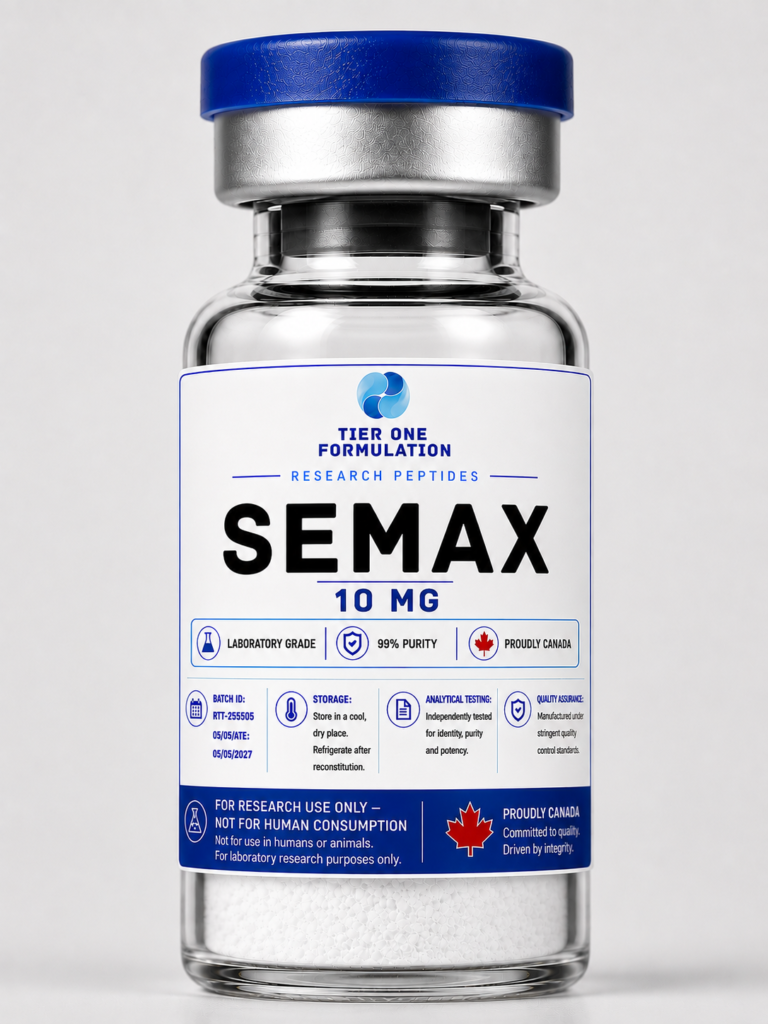
Semax Canada: 10mg Neurobiology Research Overview
Semax 10mg is supplied in Canada for laboratory research on the synthetic ACTH(4-7)-Pro-Gly-Pro heptapeptide. Molecular and preclinical studies have examined changes in neurotrophin-related gene expression, including BDNF and NGF pathways, as well as ischemia-related neurobiology models. Evidence is not equivalent to broadly replicated international clinical development, and no cognitive-enhancement or treatment claim is made.
Quick Research Profile
| Material |
Semax |
| Strength |
10mg |
| Research classification |
Synthetic ACTH(4-7)-Pro-Gly-Pro heptapeptide |
| Primary research pathways |
Neurotrophin gene expression, ACTH-derived peptide and neurobiology research |
| Literature status |
Animal, cell and regional human literature; broader independent clinical evidence is limited |
| Intended use |
Laboratory research only — not for human or veterinary use |
ACTH-Derived Peptide Research and Neurotrophin Gene Expression
A significant portion of Semax research examines changes in neurotrophin-related gene expression. Rat and cell studies have reported time-dependent changes in BDNF, NGF and related receptor transcripts after Semax exposure. These gene-expression findings are mechanistic observations and do not establish cognitive or therapeutic effects in people.
Key Semax Research Areas
- Neurotrophin signalling: BDNF, NGF and related receptor genes appear in multiple Semax studies.
- ACTH-fragment research: Semax is used to explore non-corticotropic actions of ACTH-derived peptide sequences.
- Neurobiology and ischemia models: Preclinical studies include hypoxia, ischemia and neuronal-response paradigms.
Evidence Quality and Interpretation
The literature includes molecular, animal and some regional clinical studies, but the evidence base is not equivalent to broadly replicated international clinical development.
Research Limitations and Responsible Interpretation
No memory, cognitive-enhancement, stroke-treatment or other human-use claim is made. Researchers should distinguish molecular findings from clinical outcomes and consider the limited independent replication.
Published findings describe specific experimental preparations and study conditions. They do not establish that a commercial research material is equivalent to a regulated pharmaceutical product, and they should not be interpreted as evidence of safety, efficacy or suitability for personal use.
Scientific References
References are provided for scientific context. Researchers should review the original methods, material identity, model and limitations before using published findings to inform experimental design.
Research FAQ: Semax
What is the peptide sequence concept behind Semax?
Semax is the synthetic heptapeptide ACTH(4-7)-Pro-Gly-Pro, designed from an ACTH fragment with a C-terminal Pro-Gly-Pro sequence.
Why do BDNF and NGF appear in Semax research?
Several molecular and animal studies have measured changes in neurotrophin-related gene expression, including BDNF, NGF and related receptor transcripts.
How strong is the clinical evidence for Semax?
The literature includes molecular, animal and some regional human studies, but it is not equivalent to broadly replicated international clinical development.
Is Semax 10mg presented as a nootropic or stroke treatment?
No. This listing is for laboratory research only and makes no cognitive-enhancement, neurological-treatment or personal-use claim.
Canadian Research Procurement
Tier One supplies Semax 10mg for qualified Canadian research procurement. Laboratories working with receptor pharmacology, neuroendocrine and endocrine-signalling models can review the Hormone & Endocrine Peptides collection for related materials. Product-specific identity, purity and analytical statements should be verified from current batch documentation. For research purposes only. Not for human or veterinary use or consumption.